
Why the floor decides who leases the building
Vacancy across Hamilton, Kitchener, Waterloo, Cambridge and Guelph sits at about 1.1 percent, the region holds roughly 155 million square feet of industrial space, and new purpose-built facilities ask more than $14.50 per square foot. That cuts both ways for the owner of an older building: the demand is there, but tenants compare every building against new construction and will not pay new-build rates for deferred maintenance.
Tenants weigh operating efficiency, energy cost, safety and the total cost of occupancy, and the floor touches all of them. On a tour, a cracked, stained or patched slab is read as a sign of what else has been neglected, and prospects ask when the floor was last serviced, what its load capacity is, whether there is drainage for wash-down and what floor maintenance sits inside the common area charges. An owner with maintenance records and a capital schedule answers with documents.
The four warehouse floor options compared
| System | Suits | Installed cost | Upkeep and life |
|---|---|---|---|
| Polished concrete | Distribution, e-commerce, general warehousing, multi-tenant and spec buildings | $3 to $6 per square foot | Routine cleaning only; 20 years or more |
| Epoxy coating | Food processing, pharmaceutical, chemical and specialized manufacturing | $4 to $8 per square foot | Recoat every 5 to 7 years in high-traffic areas |
| Polyurethane and MMA | Automotive, heavy machinery, high-volume forklift traffic, thermal cycling | $6 to $12 per square foot | Maintenance intervals of 10 years or more |
| Anti-fatigue systems | Assembly lines, QC stations, packaging, anywhere staff stand all day | $8 to $15 per square foot | Replaced every 3 to 5 years; used in zones, not whole floors |
Polished concrete is the slab ground and refined to a hard, glass-like finish, so there is no coating to delaminate and the surface gets denser with use. It reflects 20 to 30 percent more light than bare or coated concrete, which cuts lighting costs in a building that runs 16 hours a day, and it stays nearly dust free, which matters for electronics, food and other contamination-sensitive stock.
Epoxy forms a seamless, non-porous barrier over the slab with no joints where bacteria or chemicals can collect, which is what CFIA inspections and pharmaceutical GMP rules call for. Formulations are matched to the exposure, from organic acids to petroleum products and solvents, and colour-coded zones, anti-slip aggregate and traffic markings can be built in.
Polyurethane and MMA take point loads, gouging and thermal shock that epoxy cannot. Polyurethane stays flexible, so it rides out the seasonal slab movement without cracking or losing bond, and some MMA systems take light traffic within hours and full loading inside 24 hours, which a plant running around the clock needs.
Regulated and heavy-industry tenants have few compliant buildings to choose from, so they sign longer leases and pay a premium for one. For everything else, including multi-tenant and spec buildings, polished concrete has the widest appeal and leases up fastest.
How the return is counted
Tenant retention is the biggest number. When a tenant leaves, the owner carries four to six months of lost rent through the search, fit-out and negotiation, plus leasing commissions of 5 to 6 percent of the lease value, often $100,000 or more. A 50,000 square foot building at $13 per square foot brings in $650,000 a year, or $6.5 million over a ten-year lease; one more five-year term from the same tenant avoids all of those costs.
The rent premium is the second number. A building with a sound floor commands $1 to $2 per square foot more than a comparable one with a worn slab. At $1.50 on 50,000 square feet that is $75,000 a year, or $750,000 over ten years from a $250,000 floor. The third is operating cost: less maintenance labour, fewer service calls, lower lighting bills and less slip-and-fall exposure, all of which lift net operating income and the valuation with it.
Put together, a $300,000 floor in a 50,000 square foot warehouse breaks even in two to four years on the rent premium alone and in 18 to 36 months once avoided vacancy and lower operating costs are counted; over a ten-year lease the total return usually lands between 200 and 400 percent.
Freeze-thaw, salt and the slab
Winter lows around minus 20 degrees and summer highs around plus 30 expand and contract the slab every year. Water that gets into the concrete in late fall freezes, spalls the surface and lifts coatings; road salt tracked in through the dock doors breaks down standard coatings; summer humidity interferes with adhesion, and winter heating dries the building enough to crack a brittle formulation.
- Test the slab before coating: the calcium chloride test must show 3 pounds per 1,000 square feet or less. Older buildings without a vapour barrier under the slab need a moisture-mitigating primer or topical barrier first, or the coating delaminates from below within two or three years.
- Put a crack isolation membrane between slab and finish so the slab's seasonal hairline cracks do not telegraph through, and keep expansion joints properly sized and filled with a sealant made for industrial movement.
- Reinforce the dock zones. The 20 to 30 feet inside each dock door takes truck traffic, weather and salt, so it gets heavy-duty epoxy or polyurethane even where the main floor is polished concrete, with a salt-resistant sealer renewed each year, drainage so meltwater does not stand, and heavy-duty matting at every entrance.
Lifecycle cost, maintenance and when to replace
The first price can mislead. Polished concrete at $5 per square foot needs little beyond cleaning for 15 to 20 years; epoxy at $6 needs recoating every seven years at $3 per square foot, so over 20 years two systems with similar first prices can differ in cost of ownership by 50 to 100 percent. Set aside $0.25 to $0.50 per square foot a year as a floor reserve, $12,500 to $25,000 on a 50,000 square foot building, so maintenance never waits for capital.
Preventative care is cheap next to the alternative. An annual inspection runs $2,000 to $5,000 for a typical 50,000 square foot facility and minor resealing every three to five years runs $10,000 to $20,000. Reacting only when the floor fails costs three to five times as much: emergency repairs disrupt the tenant, neglected wear brings full replacement forward by years, and a tenant living with floor problems uses them as leverage at renewal. Documented inspections also matter if there is ever a slip-and-fall claim.
Resurfacing costs 30 to 50 percent of a new installation and is right when the wear is on the surface only: discolouration, staining, a worn coating. Cracking, spalling or delamination mean the substrate has failed and a new coating over it will fail too; find and fix any moisture source first, and plan for new concrete if the use is changing to heavy manufacturing or cold storage.
Choosing the contractor and the timing
Industrial work is not residential work scaled up. Ask for references from projects of comparable size, and from property owners rather than general contractors, because owners can say how the floor performed over the lease. Confirm general liability cover of at least $5 million, workers' compensation and bonding where the job warrants it, with the owner named as additional insured, and confirm the contractor knows the Ontario Building Code, WSIB requirements and sector rules such as CFIA coving or GMP cleanroom practice.
The best time for a major floor project is the gap between one tenant leaving and the next fit-out. In an occupied building, phase the work so part of the floor stays in service, use a fast-cure system where areas must be back within 24 hours, and give the tenant 30 to 60 days' notice with a schedule by area.
Code, insurance and resale value
The Ontario Building Code sets minimum live loads by occupancy, and an owner should be able to produce load-capacity documentation on request. AODA rules on transitions, smoothness and slip resistance apply in offices, break rooms and any area open to the public.
Appraisers rate floor condition with the other building systems, and deferred floor work is booked as deferred capital and taken off the value. A deteriorated slab might put a building at a 7 percent cap rate against 6.5 percent for a comparable one in good condition; on a $5 million property that half point is $250,000. Floor work done 6 to 12 months before a sale or refinancing typically returns 150 to 250 percent, and buyers increasingly commission floor condition reports, at $2,000 to $5,000, to negotiate credits for what they find.
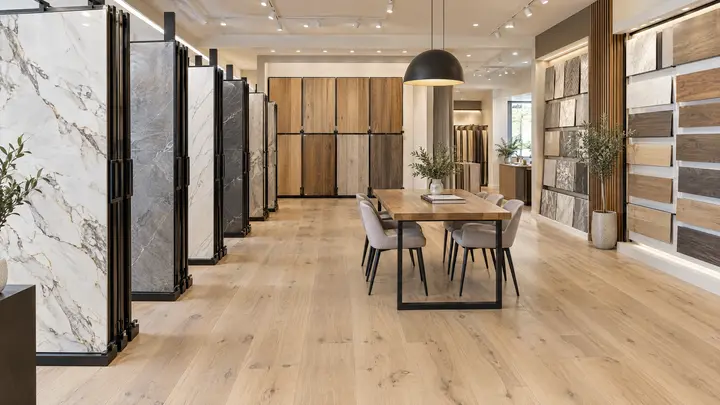
Club Ceramic Cambridge stocks commercial flooring for the offices and front-of-house areas of industrial buildings and will look at the warehouse floor itself and set out the options and costs. The showroom at 15 Sheldon Dr serves Cambridge, Kitchener, Waterloo and Guelph; start with a free estimate or see the commercial flooring on the floor.
Bring the building's floor plan and the tenant's operation to the showroom and the team will set out the options with one estimate for the whole job.