Why wood suits a bedroom
- Warmth: unlike tile or stone, wood does not feel cold at 6 am in an Ontario winter; it insulates naturally.
- Looks: wood works with any style, from farmhouse to contemporary, and its grain and colour variation add texture.
- Allergens: we spend a third of our lives in the bedroom, often close to the floor; wood does not trap dust, pet dander or allergens the way carpet does.
- Longevity: quality wood flooring lasts decades and can be refinished as styles and wear change.
- Sound: not as quiet as carpet, but softer and more natural than tile or concrete.
Solid hardwood: the classic
Solid hardwood is milled from one piece of wood, usually ¾ inch thick. Every plank is unique, it can be sanded and refinished 5 to 7 times or more over its life, and it is consistently rated among the features that add resale value. Oak is the most popular for its durability and prominent grain, maple is smoother and more contemporary, walnut gives rich dark tones, and hickory is one of the hardest domestic species with dramatic grain and colour variation. White oak is slightly harder and more water resistant than red oak.
Its limits: solid wood expands and contracts with humidity, so in the KW Region's seasonal swings it can gap in winter and cup in summer without acclimatization and steady indoor humidity. It should only go above grade, not in a basement, and usually over a wood subfloor. It costs more in materials and labour than engineered, and it can be scratched, dented or damaged by moisture, less of a worry in a bedroom than in a hallway unless you have large dogs or move furniture often.
Engineered hardwood: the usual sweet spot
Engineered hardwood is a real hardwood veneer, typically 2 mm to 6 mm thick, bonded to layers of plywood or high-density fibreboard. The layered core makes it far more stable than solid wood, so it suits homes with fluctuating humidity and radiant heating. It can be glued, stapled or floated, including in a moisture-controlled basement or over concrete. Many quality lines cost less than solid, wide planks of 7 inches and more are possible without warping, and most boards come prefinished with factory finishes tougher than site-applied ones, so installation is faster with no dust or fumes.
Its limits: a thick veneer can be refinished 1 to 3 times, a thin one not at all; quality varies widely, and cheap boards with thin veneers and poor cores will not last; and some people feel it lacks the heft of solid wood, a difference that is small with good product.
What to look for
- Veneer thickness: at least 2 mm of real wood on top, ideally 3 to 4 mm or more, so it wears like wood and can be refinished.
- Core: multi-ply plywood cores are generally more stable than HDF, though good HDF performs well.
- Finish: multi-layer factory finishes with aluminum oxide or a similar hardener.
- Locking system: for a floating install, a lock that clicks together tightly with no gaps.
Luxury vinyl plank: the practical alternative
LVP is not wood, but modern planks copy wood grain closely enough with high-resolution printing and textured surfaces to belong in this comparison. Quality LVP is fully waterproof, resists scratches, dents and stains, needs only sweeping and a damp mop, has a slight give that is easier to stand on than hardwood, often clicks together for a DIY install, usually costs less than solid or engineered wood, and comes in everything from reclaimed looks to grey tones. Some planks have an attached pad, a welcome feature in a bedroom.
Its limits: it is still vinyl, so it will not add the resale value of real wood; cheap lines repeat patterns and look plastic; some products off-gas VOCs, so look for low-VOC certification if air quality matters; and it is petroleum-based and not easily recycled. It makes sense for a basement bedroom, a rental, a home with pets or young children, a budget renovation, or a room over radiant heat.
Bamboo and reclaimed wood
Bamboo is a grass manufactured like engineered flooring. It matures in 3 to 5 years rather than decades, strand-woven bamboo is harder than oak or maple, its look is distinctive and it is reasonably stable. Quality varies dramatically, though, with soft cheap imports and formaldehyde in some adhesives; most bamboo can be refinished only once or twice; darker carbonized bamboo fades in sunlight; and it can look out of place in a heritage home in Cambridge or Paris.
Reclaimed wood, salvaged from old barns and factories and milled into flooring, has nail holes, saw marks and patina no new board can copy, keeps old-growth timber out of landfill, and is often denser and more stable than young wood. The salvage, denailing and milling make it expensive, often dearer than new solid hardwood; finding enough matching stock for a whole room is hard; thickness varies, which complicates installation; and hidden metal, defects or insect damage can turn up mid-job.
What decides it for your room
Climate: the KW Region's dry heated winters and humid summers favour engineered hardwood or quality LVP unless you control humidity carefully. If the bedroom has an ensuite, keep solid hardwood away from the bathroom door or ventilate well and wipe water up fast.
Subfloor: concrete, common in basements and newer homes, rules out solid hardwood; use engineered (glued or floating) or LVP. Wood subfloors, common in older Cambridge and Kitchener homes, allow any method once the floor is level, dry and sound. Over radiant heat, choose engineered or LVP; solid hardwood does not perform well on it.
Sound: use a quality underlayment under a floating floor, consider cork for extra dampening, and use rugs, which cut noise noticeably.
Upkeep: LVP needs the least; engineered hardwood needs regular sweeping, wood-specific cleaners, felt pads and prompt spill cleanup; solid hardwood needs the most, with humidity monitoring, refinishing every 10 to 20 years and care against scratches. With dogs, choose harder species such as maple or hickory, or LVP; pine and fir scratch readily.
| Bedroom style | Floor to consider |
|---|---|
| Traditional or classic | Solid oak or maple in medium tones; reclaimed wood in a heritage home |
| Contemporary or modern | Wide-plank engineered hardwood in grey tones, or strand-woven bamboo |
| Rustic or farmhouse | Hickory with natural colour variation, or distressed reclaimed boards |
| Scandinavian or minimalist | Light maple or white oak in wide planks |
| Warm and cozy | Walnut, cherry, or LVP in honey or amber tones |
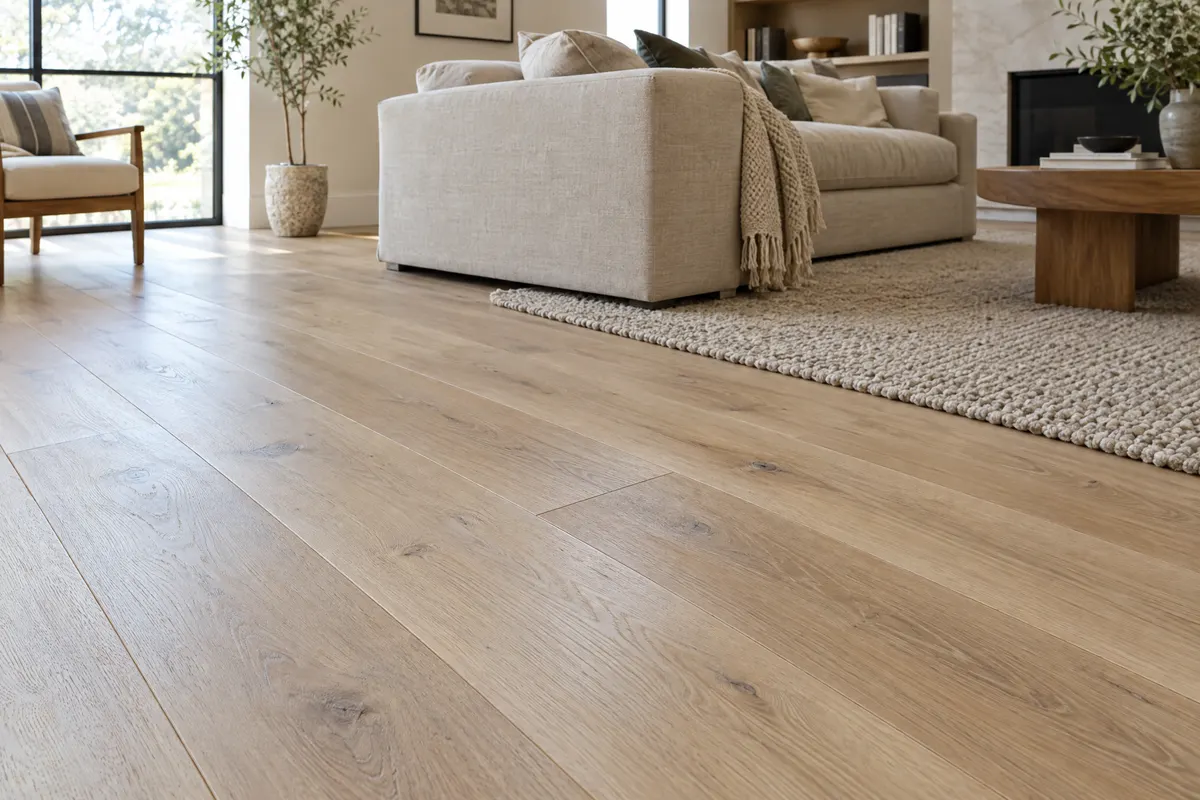
Wider planks read more modern, matte finishes are ahead of gloss, and the colour treatment (natural, stained or whitewashed) changes the room as much as the species does.
Installation, and seeing the boards first
Good flooring installed badly performs badly. Wood products, solid, engineered and bamboo, must acclimatize to the home's temperature and humidity for 3 to 7 days before installation. The subfloor must be clean, level, dry and structurally sound, or every flaw telegraphs through the finished floor. Solid hardwood is best left to professionals; floating engineered boards or LVP can be a DIY job for a patient person with moderate skills, though a bedroom is an important room to get right. Spring and fall, when humidity is steadier, are the easiest times to install here.
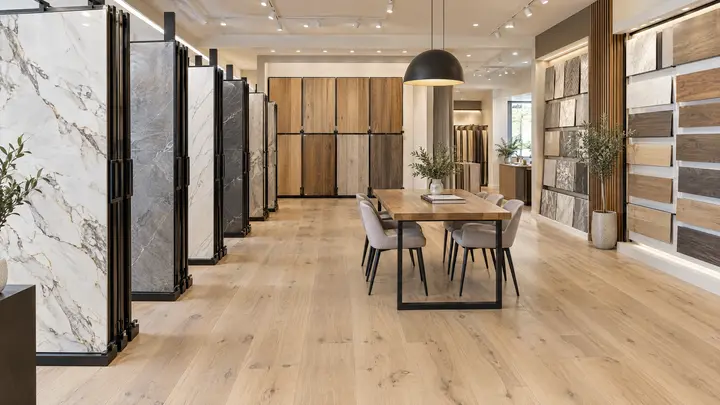
Texture, colour variation and finish only show properly in person. The showroom at 15 Sheldon Dr in Cambridge has solid and engineered hardwood and vinyl plank on the floor to walk on and compare side by side, and a free estimate covers the boards and the installation for Cambridge, Kitchener, Waterloo and Guelph.
Walk on solid, engineered and vinyl plank boards side by side at 15 Sheldon Dr, or tell us the bedroom's size for an estimate.